질량수(質量數)
★ mass number 질량수, 원자 질량.
[뜻] 어떤 원자의 원자 질량(atomic mass)는 원자핵을 이루는 양성자와 중성자의 질량의 합으로 표현할 수 있고, 이를 종종 질량수라고 말한다. 여기서 전자의 질량은 양성자 또는 중성자 질량에 비해 훨씬 가볍기 때문에 무시할 수 있으며, 양성자와 중성자의 질량을 표준화하여 정수로 표현이 가능하다. 수식으로 표현하면 아래와 같다.
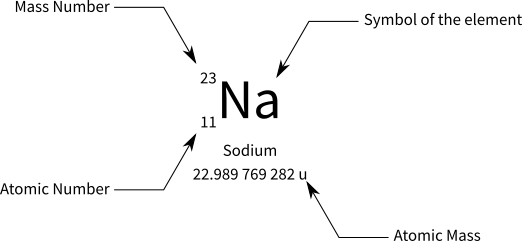
* The mass number (A) is the total number of neutrons and protons present in the nucleus of an atom of an element. Except for the most common form of hydrogen, which has one proton and no neutrons, all atomic nuclei contain both protons and neutrons. Collectively, protons and neutrons are called nucleons. A nucleon is a particle within the nucleus. In general, the mass number is given by
mass number (A) = number of protons (Z) + number of neutrons
The number of neutrons in an atom equals the difference between the mass number and the atomic number, or (A − Z). For example, the mass number of fluorine is 19 and the atomic number is 9 (indicating 9 protons in the nucleus). Thus, the number of neutrons in an atom of fluorine is 19 − 9 = 10. The atomic number, number of neutrons, and mass number all must be positive integers (whole numbers).
[출처: Chemistry by Julia R. Burdge]