커패시터
★ capacitor [전기] 축전기, 콘덴서.
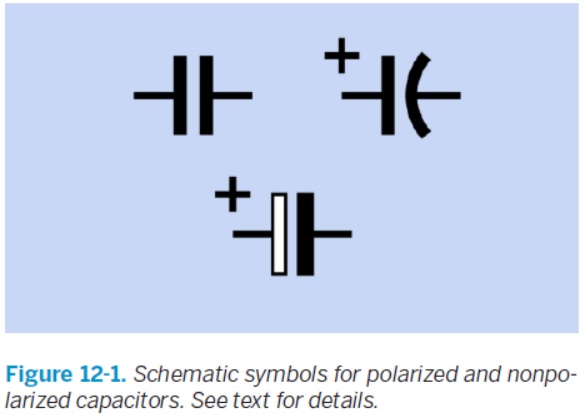
Quite often referred to as a cap. Formerly known (primarily in the United Kingdom) as a condenser, but that term has become obsolete. . . . A capacitor connected across a DC power source will accumulate a charge, which then persists after the source is disconnected. In this way, the capacitor stores (and can then discharge) energy like a small rechargeable battery. The charge/discharge rate is extremely fast but can be limited by a series resistor, which enables the capacitor to be used as a timing component in many electronic circuits. A capacitor can also be used to block DC current while it passes pulses, or electrical “noise,” or alternating current, or audio signals, or other wave forms. This capability enables it to smooth the output voltage provided by power supplies; to remove spikes from signals that would otherwise tend to cause spurious triggering of components in digital circuits; to adjust the frequency response of an audio circuit; or to couple separate components or circuit elements that must be protected from transmission of DC current. Schematic symbols for capacitors are shown in Figure 12-1. At top-left is a nonpolarized capacitor, while the other two indicate that a polarized capacitor must be used, and must be oriented as shown. The variant at the bottom is most commonly used in Europe. Confusingly, the nonpolarized symbol may also be used to identify a polarized capacitor, if a + sign is added. The polarized symbols are sometimes printed without + signs, but the symbols still indicate that polarity must be observed.
In its simplest form, a capacitor consists of two plates, each with a lead attached to it for connection
with a DC power source. The plates are separated by a thin, insulating layer known as the dielectric, which is usually a solid or a paste but may be liquid, gel, gaseous, or vacuum.
[출처: Charles Platt, Encyclopedia of Electronic Components Volume 1 Resistors, Capacitors, Inductors, Switches, Encoders, Relays, Transistors]
☆ cylindrical capacitor 원통형 커패시터.
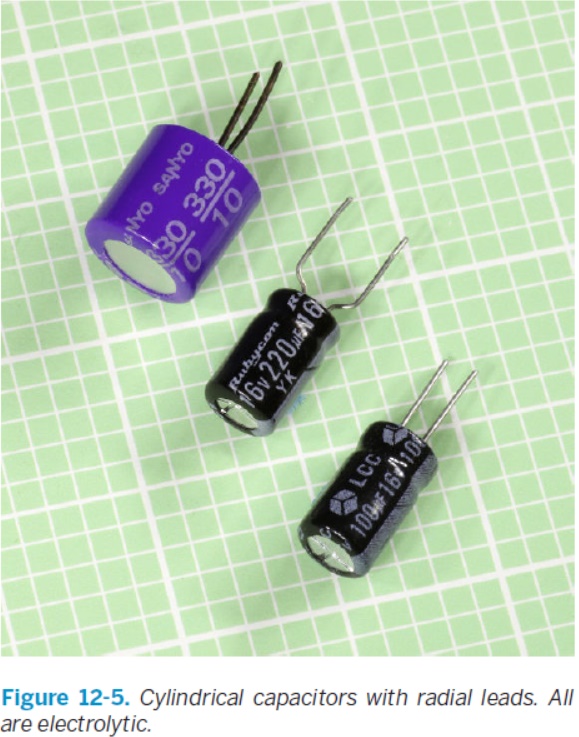
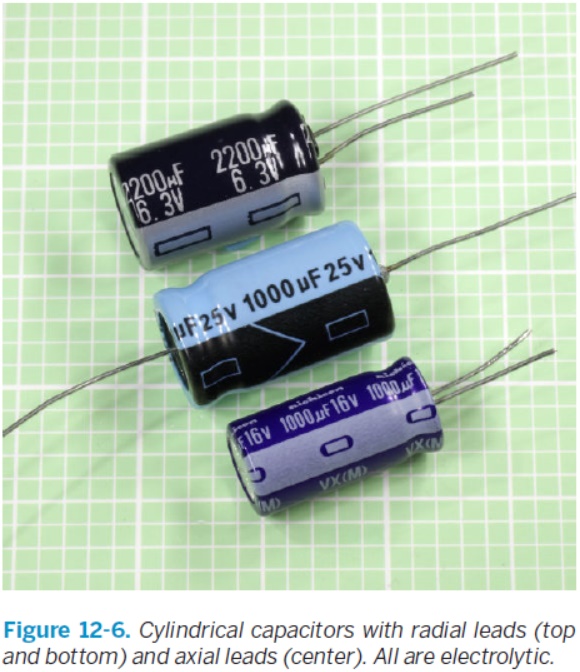
A cylindrical capacitor may have axial leads (a wire attached to each end) or radial leads (both wires emerging from one end). Radial capacitors are more widely used as they allow easy insertion into a circuit board. The capacitor is usually packaged in a small aluminum can, closed at one end, capped with an insulating disc at the other end, and wrapped in a thin layer of insulating plastic. Some samples are shown in Figure 12-5 and Figure 12-6.
[출처: Charles Platt, Encyclopedia of Electronic Components Volume 1 Resistors, Capacitors, Inductors, Switches, Encoders, Relays, Transistors]
☆ surface-mount capacitor 표면 실장 커패시터.
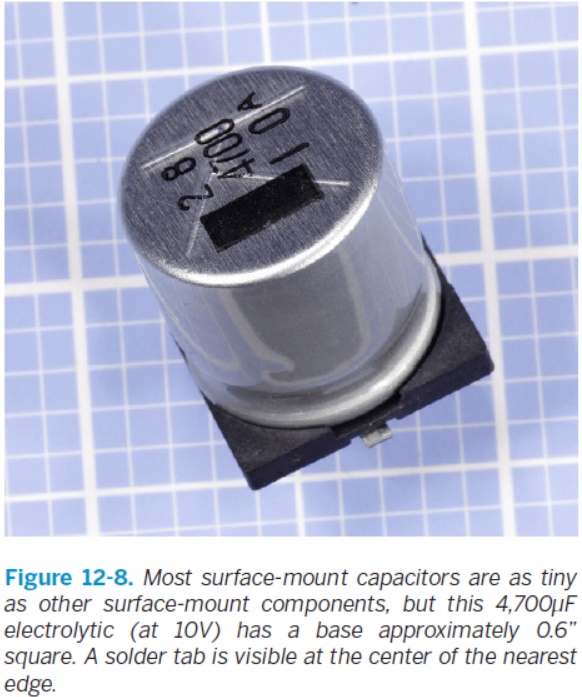
A surface-mount capacitor is square or rectangular, usually a few millimeters in each dimension, with two conductive pads or contacts at opposite ends. It appears almost identical to a surfacemount resistor. Larger-value capacitors are inevitably bigger but can still be designed for surfacemount applications. See Figure 12-8.
[출처: Charles Platt, Encyclopedia of Electronic Components Volume 1 Resistors, Capacitors, Inductors, Switches, Encoders, Relays, Transistors]