코어
★ core [컴퓨터] 자심(磁心) 기억 장치. (= core memory)
* Intel, along with its rivals, is embracing a new approach to chip design, in which performance is improved not through higher clock speeds, but by adding further processing “cores” to its existing chips.
* Intel, along with its rivals, is embracing a new approach to chip design, in which performance is improved not through higher clock speeds, but by adding further processing “cores” to its existing chips.
★ core [전기] (변압기의) 코어.
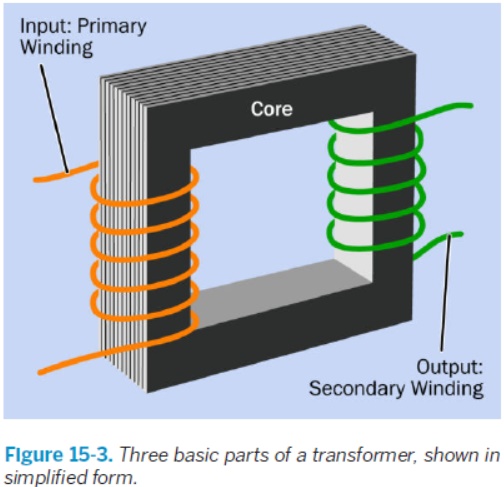
The ferromagnetic core is often described as being made of iron, but in reality is more often fabricated
from high permeability silicon steel. To reduce losses caused by eddy currents, the core is usually laminated—assembled from a stack of plates separated from each other by thin layers of varnish or a similar insulator. Eddy currents tend to be constrained within the thickness of each plate.
from high permeability silicon steel. To reduce losses caused by eddy currents, the core is usually laminated—assembled from a stack of plates separated from each other by thin layers of varnish or a similar insulator. Eddy currents tend to be constrained within the thickness of each plate.
[출처: Charles Platt, Encyclopedia of Electronic Components Volume 1 Resistors, Capacitors, Inductors, Switches, Encoders, Relays, Transistors]
★ core [금형, 주조] 코어, 심형(心型)
[뜻] 성형품의 내면을 형성하기 위한 금형의 돌출 부분, 즉 플런저, 언더 컷부를 성형하기 위해서 사용되는 금형 부분, 압출 성형용 금형에서 중공체를 성형시키기 위한 내부형, 금형 내의 냉각수 홈이나 히터용으로 뚫은 구멍, 샌드위치 구조의 심재.
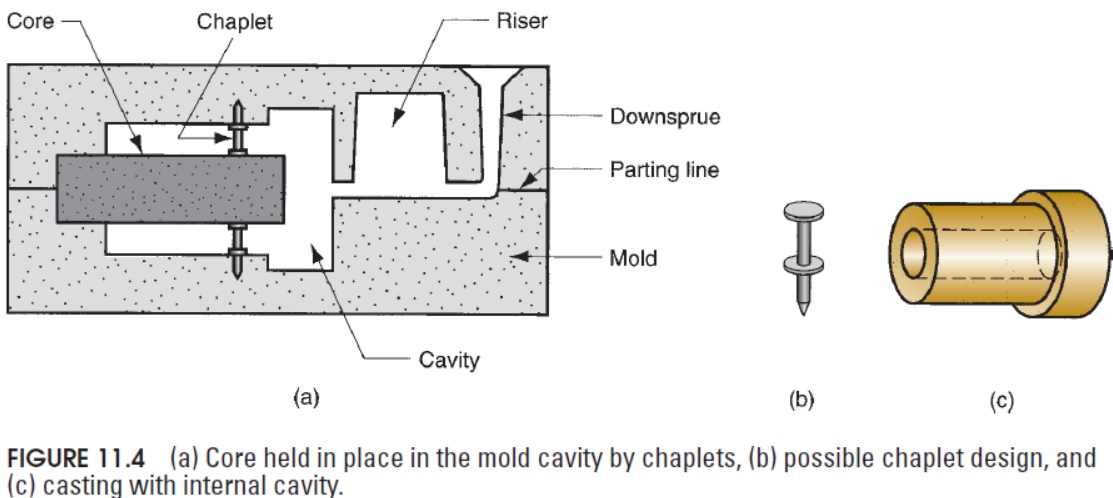
* Patterns define the external shape of the cast part. If the casting is to have internal surfaces, a core is required. A core is a full-scale model of the interior surfaces of the part. It is inserted into the mold cavity prior to pouring, so that the molten metal will flow and solidify between the mold cavity and the core to form the casting’s external and internal surfaces. The core is usually made of sand, compacted into the desired shape. As with the pattern, the actual size of the core must include allowances for shrinkage and machining. Depending on the geometry of the part, the core may or may not require supports to hold it in position in the mold cavity during pouring. These supports, called chaplets, are made of a metal with a higher melting temperature than the casting metal. For example, steel chaplets would be used for cast iron castings. On pouring and solidifi cation, the chaplets become bonded into the casting. A possible arrangement of a core in a mold using chaplets is sketched in Figure 11.4. The portion of the chaplet protruding from the casting is subsequently cut off.
[출처: Mikell P. Groover, Fundamentals of Modern Manufacturing Materials, Processes, and Systems]