판금가공
★ sheet metalworking 판금가공(板金加工)
* Sheet metalworking processes are forming and cutting operations performed on metal sheets, strips, and coils. The surface area–to–volume ratio of the starting metal is high; thus, this ratio is a useful means to distinguish bulk deformation from sheet metal processes. Pressworking is the term often applied to sheet metal operations because the machines used to perform these operations are presses (presses of various types are also used in other manufacturing processes). A part produced in a sheet metal operation is often called a stamping.
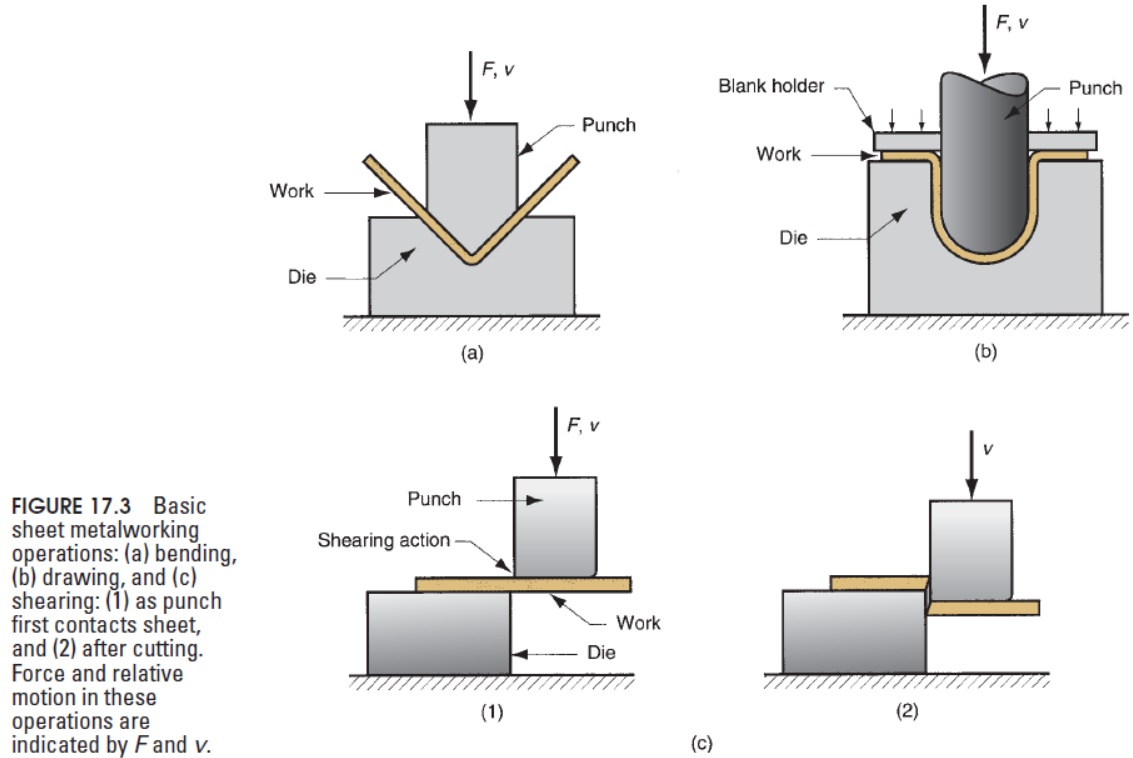
Sheet metal operations are always performed as cold working processes and are usually accomplished using a set of tools called a punch and die. The punch is the positive portion and the die is the negative portion of the tool set. The basic sheet metal operations are sketched in Figure 17.3 and are defi ned as follows:
➢ Bending. Bending involves straining of a metal sheet or plate to take an angle along a (usually) straight axis.
➢ Drawing. In sheet metalworking, drawing refers to the forming of a flat metal sheet into a hollow or concave shape, such as a cup, by stretching the metal. A blankholder is used to hold down the blank while the punch pushes into the sheet metal, as shown in Figure 17.3(b). To distinguish this operation from bar
and wire drawing, the terms cup drawing or deep drawing are often used.
➢ Shearing. This process seems somewhat out-of-place in a list of deformation processes, because it involves cutting rather than forming. A shearing operation cuts the work using a punch and die, as in Figure 17.3(c). Although it is not a forming process, it is included here because it is a necessary and very common operation in sheet metalworking.
[출처: Mikell P. Groover, Fundamentals of Modern Manufacturing Materials, Processes, and Systems]