플라즈마 식각
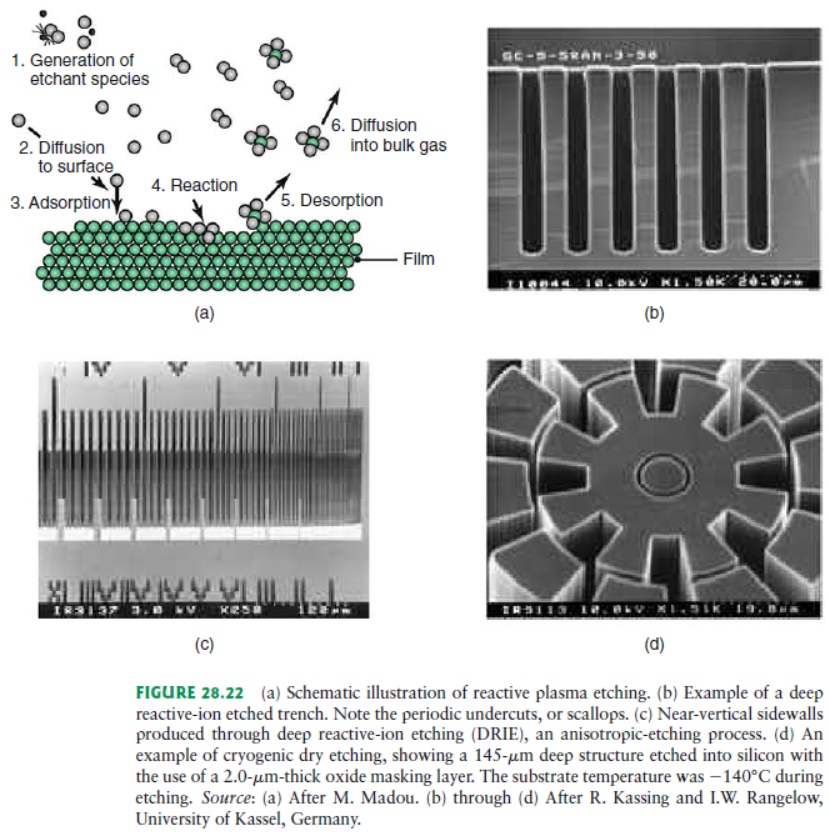
[Source: Serope Kalpakjian, Steven R. Schmid, Manufacturing Engineering and Technology]
★ plasma etching 플라즈마 식각.
This etching process uses an ionized gas to etch a target material. The ionized gas is created by introducing an appropriate gas mixture into a vacuum chamber and using radio frequency (RF) electrical energy to ionize a portion of the gas, thus creating a plasma. The high-energy plasma reacts with the
target surface, vaporizing the material to remove it. There are several ways in which a plasma can be used to etch a material; the two principal processes in IC fabrication are plasma etching and reactive ion etching.
In plasma etching, the function of the ionized gas is to generate atoms or molecules that are chemically very reactive, so that the target surface is chemically etched upon exposure. The plasma etchants are usually based on fl uorine or chlorine gases. Etch selectivity is generally more of a problem in plasma etching than in wet chemical etching. For example, etch selectivity for SiO2 over Si in a typical plasma etching process is 15 at best, compared with infi nity when HF chemical etching is used.
[출처: Mikell P. Groover, Fundamentals of Modern Manufacturing Materials, Processes, and Systems]