호닝 가공
★ honing 호닝 (가공)
Honing is an abrasive process performed by a set of bonded abrasive sticks. A common application is to fi nish the bores of internal combustion engines. Other applications include bearings, hydraulic cylinders, and gun barrels. Surface fi nishes of around 0.12 mm (5 m-in) or slightly better are typically achieved in these applications. In addition, honing produces a characteristic cross-hatched surface that tends to retain lubrication during operation of the component, thus contributing to its function and service life.
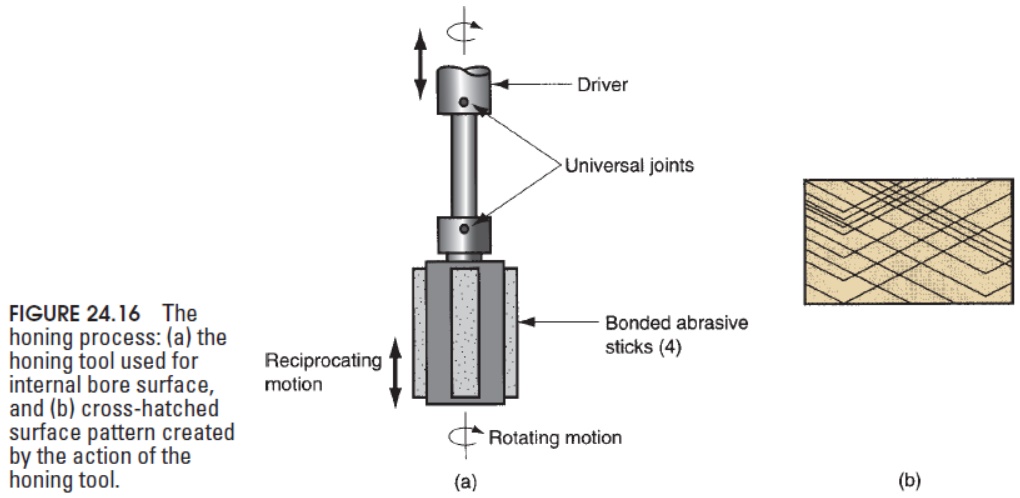
The honing process for an internal cylindrical surface is illustrated in Figure 24.16. The honing tool consists of a set of bonded abrasive sticks. Four sticks are used on the tool shown in the fi gure, but the number depends on hole size. Two to four sticks would be used for small holes (e.g., gun barrels), and a dozen or more would be used for larger diameter holes. The motion of the honing tool is a combination of rotation
and linear reciprocation, regulated in such a way that a given point on the abrasive stick does not trace the same path repeatedly. This rather complex motion accounts for the cross-hatched pattern on the bore surface. Honing speeds are 15 to 150 m/min (50–500 ft/min) [3]. During the process, the sticks are pressed outward against the hole surface to produce the desired abrasive cutting action. Hone pressures of
1 to 3 MPa (150–450 lb/in2) are typical. The honing tool is supported in the hole by two universal joints, thus causing the tool to follow the previously defi ned hole axis. Honing enlarges and fi nishes the hole but cannot change its location. Grit sizes in honing range between 30 and 600. The same trade-off between better finish and faster material removal rates exists in honing as in grinding. The amount of material removed from the work surface during a honing operation may be as much as 0.5 mm (0.020 in), but is usually much less than this. A cutting fl uid must be used in honing to cool and lubricate the tool and to help remove the chips.
[출처: Mikell P. Groover, Fundamentals of Modern Manufacturing Materials, Processes, and Systems]