화학 블랭킹
★ chemical blanking 화학 블랭킹.
Chemical blanking uses chemical erosion to cut very thin sheetmetal parts—down to 0.025 mm (0.001 in) thick and/or for intricate cutting patterns. In both instances, conventional punch-and-die methods do not work because the stamping forces damage the sheet metal, or the tooling cost would be prohibitive, or both. Chemical blanking produces parts that are burr free, an advantage over conventional shearing operations. Methods used for applying the maskant in chemical blanking are either the photo resist method or the screen resist method. For small and/or intricate cutting patterns and close tolerances, the photoresist method is used. Tolerances as close as +/- 0.0025 mm (+/-0.0001 in) can be held on 0.025-mm (0.001-in)-thick stock using the photoresist method of masking. As stock thickness increases, more generous tolerances must be allowed. Screen resist masking methods are not nearly so accurate as photoresist. The small work size in chemical blanking excludes the cut and peel maskant method.
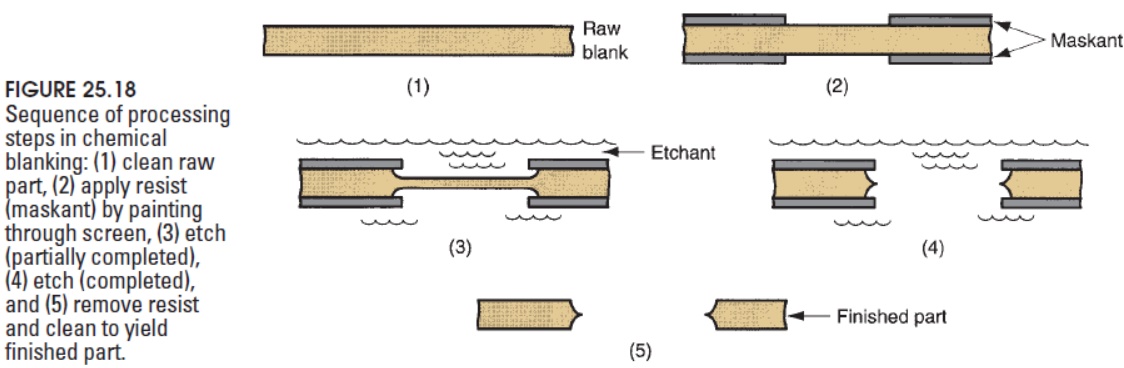
[출처: Mikell P. Groover, Fundamentals of Modern Manufacturing Materials, Processes, and Systems]