환편기
★ circular knitting machine 환편기
With circular knitting machines, the knits are always tubular. Depending on the diameter of the knit, small and large circular knitting machines are distinguished. Large circular knitting machines are mainly used to produce flat goods, such as T-shirts and underwear, whereas on small circular knitting machines mainly socks and stockings are manufactured.
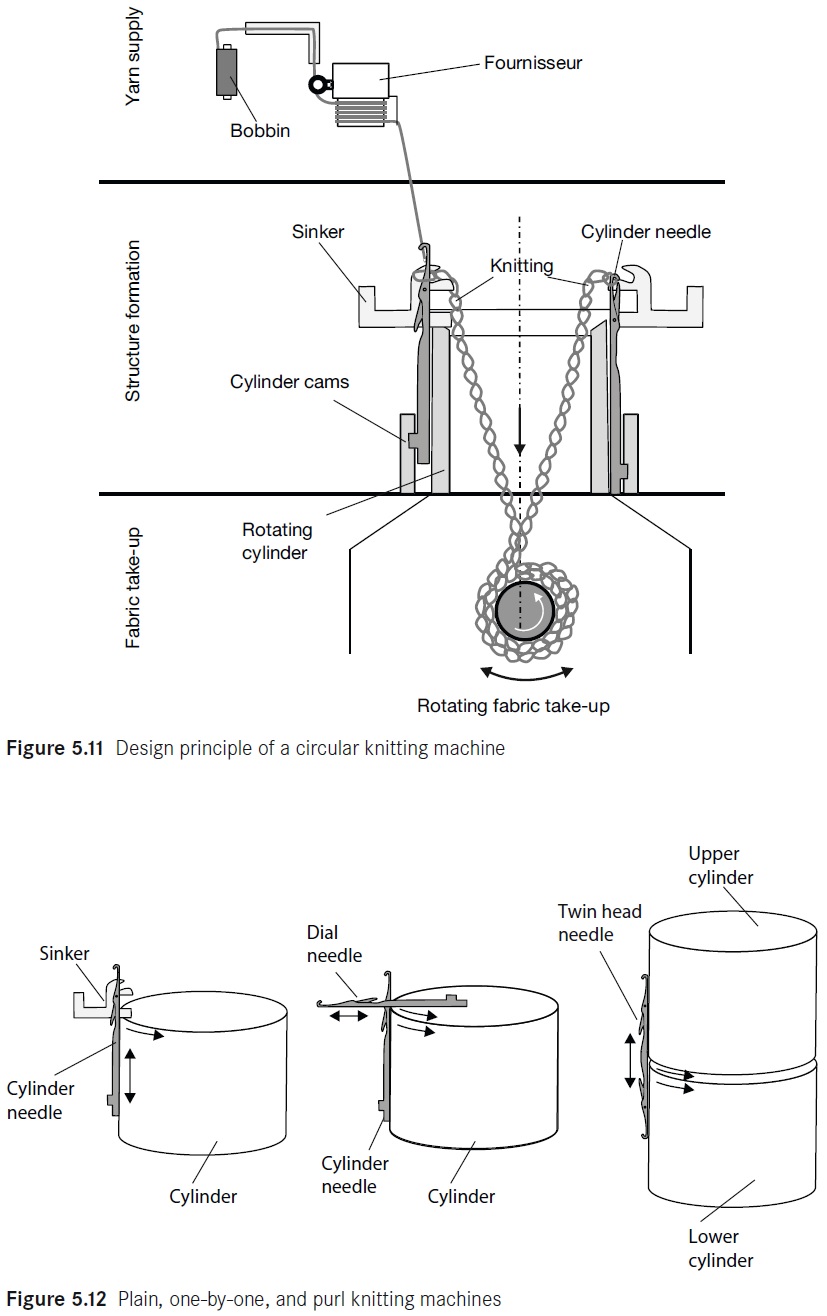
In contrast to flat-bed knitting where the needles are raised by movable cams, in circular knitting the cams stand still and the needles move around. The threads are fed through tensioners (“fournisseur”) to keep yarn tension constant. The produced fabric is taken up inside the needle bed cylinder, where the take-up also rotates together with the needle bed (Fig. 5.11).
Circular knitting machines can produce one-by-one knits as well as purl knits (Fig. 5.12). Plain-knitting machines, in addition to the cylinder with the needle beds, have a rib disk, as seen in Fig. 5.5. In this disc, the needles can move radially. During knitting, the disc rotates and the needles then pass along the stationary rip cams.
Machines for purl knits have two rotating cylinders on top of each other. When the needle channels are aligned, needles can change from one cylinder to the other.
[출처: Thomas Gries et al., Textile Technology, 2nd Ed., HANSER]