회전성형
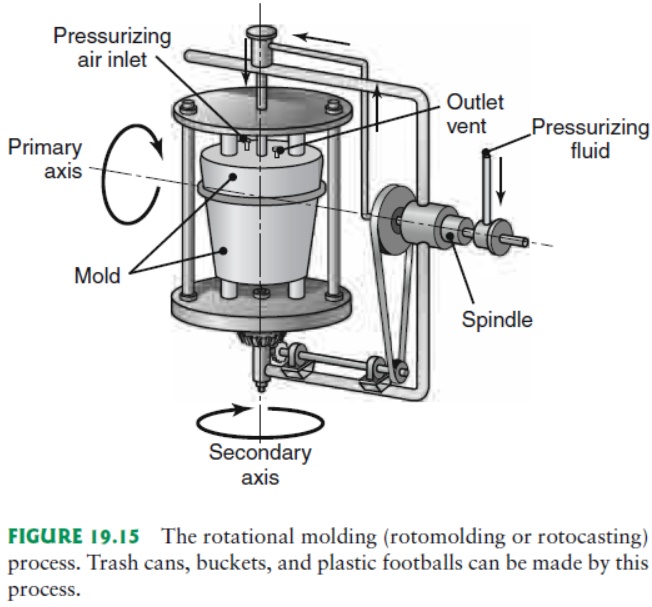
Most thermoplastics and some thermosets can be formed into large, hollow parts by rotational molding. In this process, a thin-walled metal mold is made in two pieces (split-female mold) and is designed to be rotated about two perpendicular axes (Fig. 19.15). For each part cycle, a premeasured quantity of powdered plastic material is placed inside the warm mold. (The powder is obtained from a polymerization process that precipitates a powder from a liquid.) Then the mold is heated (usually in a large oven) and is rotated continuously about the two principal axes. This action tumbles the powder against the mold, where the heat fuses the powder without melting it. For thermosetting parts, a chemical agent is added to the powder; cross-linking occurs after the part is formed in the mold. The machines are highly automated, with parts moved by an indexing mechanism similar to that shown in Fig. 19.14c. A large variety of parts are made by rotational molding, such as storage tanks of various sizes, trash cans, boat hulls, buckets, housings, large hollow toys, carrying cases, and footballs. Various metallic or plastic inserts or components also may be molded integrally into the parts made by this process. In addition to powders, liquid polymers (plastisols) can be used in rotational molding—PVC plastisols being the most common material.
In this operation (called slush molding or slush casting), the mold is heated and rotated simultaneously. Due to the tumbling action, the polymer is forced against the inside walls of the mold, where it melts and coats the mold walls. The part is cooled while it is still rotating and removed by opening the mold. Parts made are typically thin-walled products, such as boots and toys.
[Source: Serope Kalpakjian, Steven R. Schmid, Manufacturing Engineering and Technology]
★ rotational molding 회전성형(回轉成形).