백라이트
★ backlight [LCD] 백라이트.
Figure 17-2 shows a simplified view of an LCD that uses a backlight. Incoherent light emerges from the backlight panel (A) and enters a vertical polarizing filter (B) that limits the electric field vector. The polarized light then enters a liquid crystal (C) which is a liquid composed of molecules organized in a regular helical structure that rotates the polarity by 90 degrees when no voltage is applied to it. The light now passes through a horizontal polarizing filter (D) and is visible to the user. A liquid crystal itself does not emit light. It can only modify light that passes through it. A transmissive LCD requires a backlight to be visible, and is the type illustrated in Figure 17-2. In its simplest form, it is a monochrome device, but is often enhanced to display full color by adding red, green, and blue filters. Alternatively, instead of a white backlight, an array of pixel-sized red, green, and blue LEDs may be used, in which case filters are unnecessary.
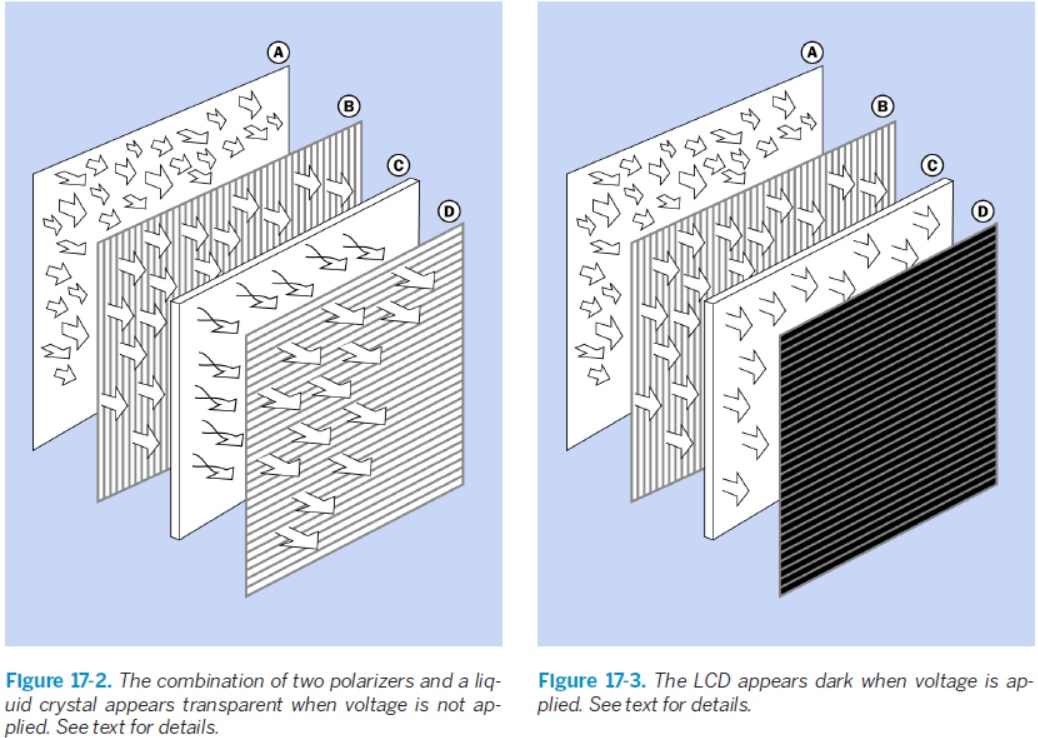
[출처: Charles Platt, Encyclopedia of Electronic Components Volume 2 LEDs, LCDs, Audio, Thyristors, Digital Logic, and Amplification]