고주파 저항 용접
★ high frequency resistance welding 고주파 저항 용접.
High-frequency resistance welding (HFRW) is a resistance-welding process in which a high-frequency alternating current is used for heating, followed by the rapid application of an upsetting force to cause coalescence, as in Figure 29.20(a). The frequencies are 10 to 500 kHz, and the electrodes make contact with the work in the immediate vicinity of the weld joint. In a variation of the process, called high-frequency induction welding (HFIW), the heating current is induced in the parts by a high-frequency induction coil, as in Figure 29.20(b). The coil does not make physical contact with the work. The principal applications of both HFRW and HFIW are continuous butt welding of the longitudinal seams of metal pipes and tubes.
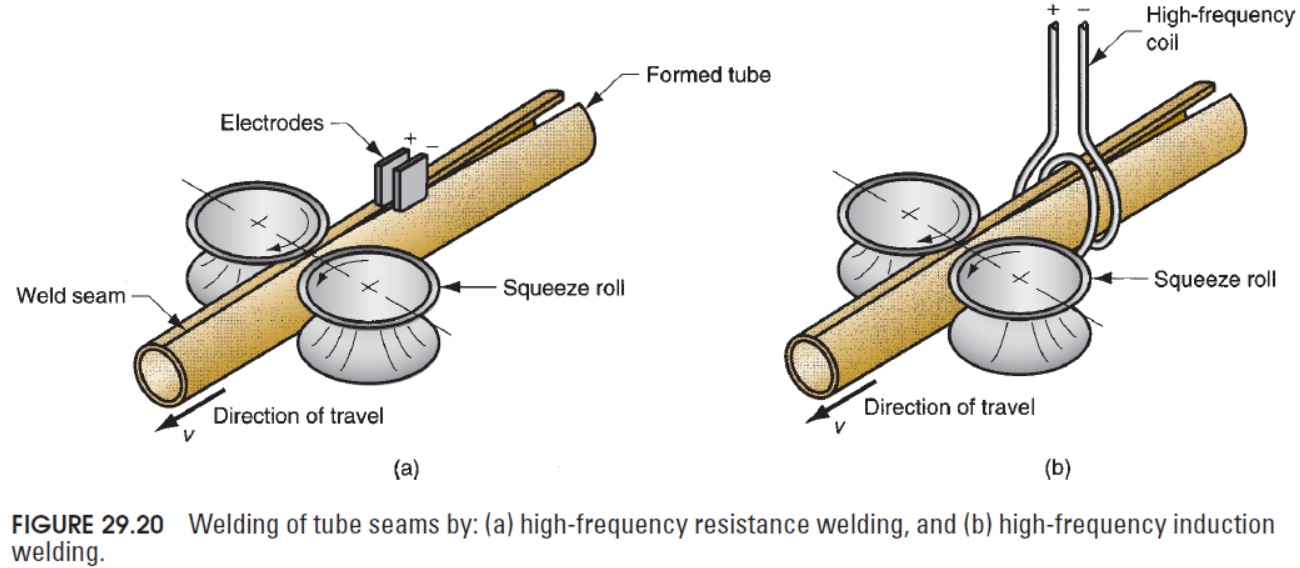
[출처: Mikell P. Groover, Fundamentals of Modern Manufacturing Materials, Processes, and Systems]