비스코스
★ viscose [화학] 비스코스(레이온·셀로판 따위의 원료); [섬유] (= viscose rayon) 비스코스 레이온, 인조견.
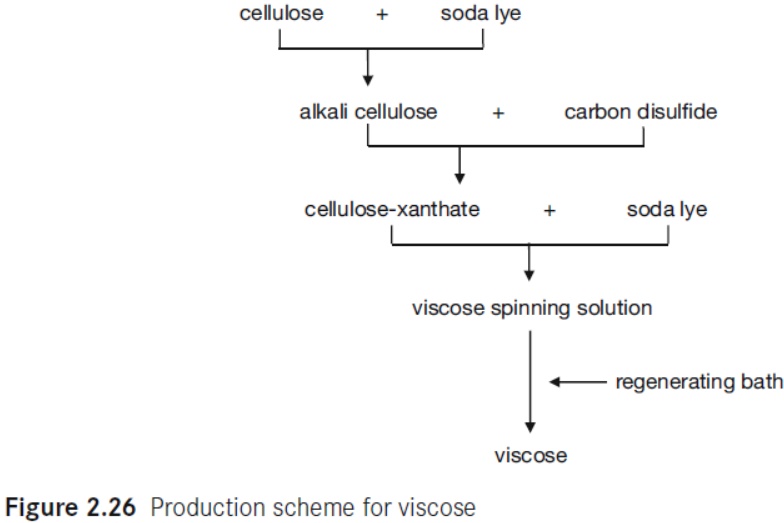
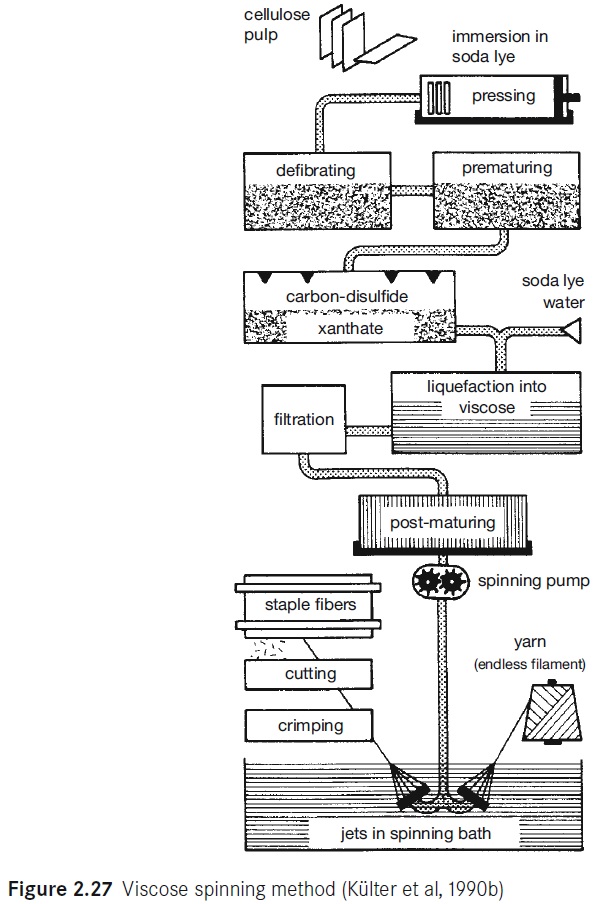
The flow chart for the production of viscose is depicted in Fig. 2.26, and the spinning method is shown in Fig. 2.27.
With the separation of the filaments in the spinning bath, regeneration of the cellulose with sulfuric acid takes place by splitting the sodium cellulose xanthogenate into cellulose, carbon disulfide, and sodium sulfate. The sodium sulfate in the spinning bath promotes the coagulation (solidification) of the viscose. The additives of the spinning solution, the composition of the spinning bath, the spinning bath temperature, and the spinning speed are adjusted depending on the kind of fiber to be spun.
After spinning, the filaments need to be drawn so as to achieve a regular orientation of the chain molecules. The drawing procedure improves the fiber properties such as tenacity and abrasion resistance. The total draw ratio is about 20% for standard fibers and up to 150% for high-tenacity fibers.
After spinning, the filaments need to be drawn so as to achieve a regular orientation of the chain molecules. The drawing procedure improves the fiber properties such as tenacity and abrasion resistance. The total draw ratio is about 20% for standard fibers and up to 150% for high-tenacity fibers.
Right after spinning, the filament yarns or staple fibers are subjected to further treatments to remove impurities, to even out certain characteristics or increase the brightness, and to improve adhesive and frictional properties. These treatments include washing, desulfurization, bleaching, application of finish, and drying.
[출처: Thomas Gries et al., Textile Technology, 2nd Ed., HANSER]