접착제 결합
★ adhesive bonding 접착제 결합, 접착결합.
Adhesive bonding is a joining process in which a fi ller material is used to hold two (or more) closely spaced parts together by surface attachment. The fi ller material that binds the parts together is the adhesive. It is a nonmetallic substance—usually a polymer. The parts being joined are called adherends. Adhesives of greatest interest in engineering are structural adhesives, which are capable of forming strong,
permanent joints between strong, rigid adherends. A large number of commercially available adhesives are cured by various mechanisms and suited to the bonding of various materials. Curing refers to the process by which the adhesive’s physical properties are changed from a liquid to a solid, usually by chemical reaction, to accomplish the surface attachment of the parts. The chemical reaction may involve polymerization, condensation, or vulcanization. Curing is often motivated by heat and/or a catalyst, and pressure is sometimes applied between the two parts to activate the bonding process. If heat is required, the curing temperatures are relatively low, and so the materials being joined are usually unaffected—an advantage for adhesive bonding. The curing or hardening of the adhesive takes time, called curing time or setting time. In some cases this time is signifi cant—generally a disadvantage in manufacturing.
permanent joints between strong, rigid adherends. A large number of commercially available adhesives are cured by various mechanisms and suited to the bonding of various materials. Curing refers to the process by which the adhesive’s physical properties are changed from a liquid to a solid, usually by chemical reaction, to accomplish the surface attachment of the parts. The chemical reaction may involve polymerization, condensation, or vulcanization. Curing is often motivated by heat and/or a catalyst, and pressure is sometimes applied between the two parts to activate the bonding process. If heat is required, the curing temperatures are relatively low, and so the materials being joined are usually unaffected—an advantage for adhesive bonding. The curing or hardening of the adhesive takes time, called curing time or setting time. In some cases this time is signifi cant—generally a disadvantage in manufacturing.
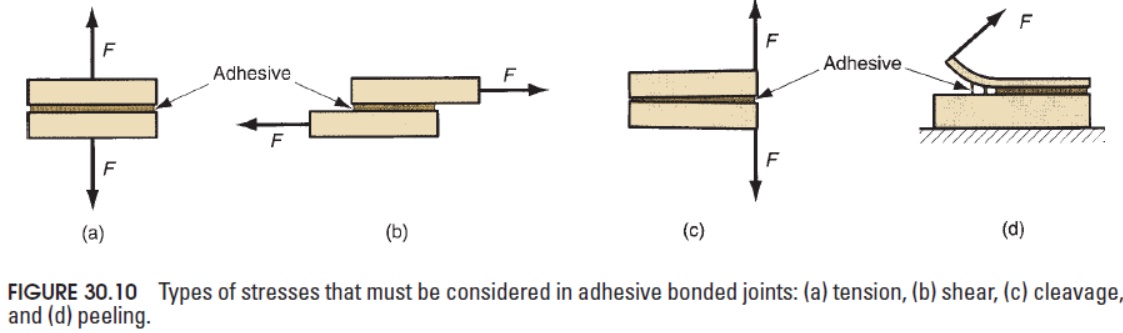
[출처: Mikell P. Groover, Fundamentals of Modern Manufacturing Materials, Processes, and Systems]