플라즈마 아크 용접
[Source: Serope Kalpakjian, Steven R. Schmid, Manufacturing Engineering and Technology]
★ plasma arc welding 플라즈마 아크 용접.
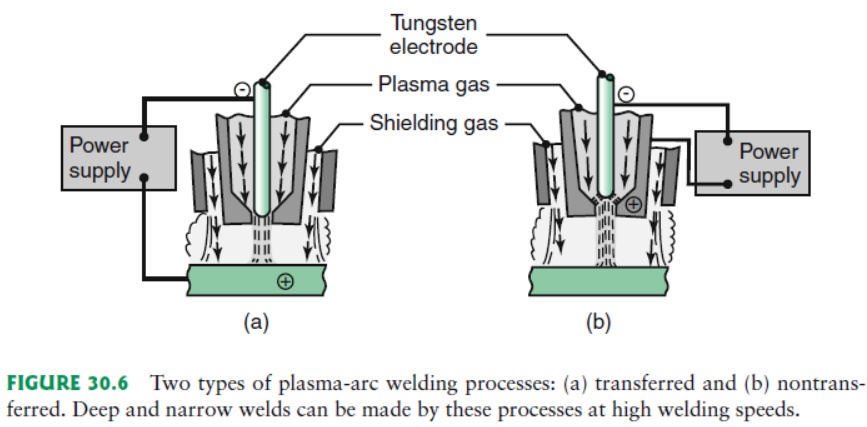
[뜻] 플라즈마 아크 용접(PAW)은 가스 텅스텐 아크 용접(GTAW)과 유사한 아크 용접 공정이다. 전기 아크는 전극과 공작물 사이에서 형성된다. 아크 플라즈마 가스의 임시 상태이다.[1] 가스는 그것을 통해 전류가 통과한후에 이온화되고 그것은 전기 전도체가 된다. 이러한 상태는 전자의 많은 수가 자신의 궤도에서 가져온대로 존재한다.
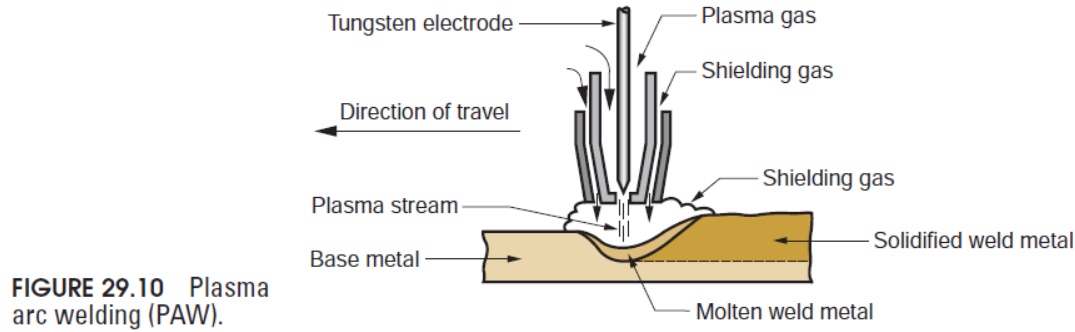
Plasma arc welding (PAW) is a special form of gas tungsten arc welding in which a constricted plasma arc is directed at the weld area. In PAW, a tungsten electrode is contained in a specially designed nozzle that focuses a highvelocity stream of inert gas (e.g., argon or argon–hydrogen mixtures) into the region
of the arc to form a high-velocity, intensely hot plasma arc stream, as in Figure 29.10. Argon, argon–hydrogen, and helium are also used as the arc-shielding gases. Temperatures in plasma arc welding reach 17,000°C (30,000°F) or greater, hot enough to melt any known metal. The reason why temperatures are so high in PAW (signifi cantly higher than those in GTAW) derives from the constriction of the arc. Although the typical power levels used in PAW are below those used in GTAW, the power is highly concentrated to produce a plasma jet of small diameter and very high power density.
of the arc to form a high-velocity, intensely hot plasma arc stream, as in Figure 29.10. Argon, argon–hydrogen, and helium are also used as the arc-shielding gases. Temperatures in plasma arc welding reach 17,000°C (30,000°F) or greater, hot enough to melt any known metal. The reason why temperatures are so high in PAW (signifi cantly higher than those in GTAW) derives from the constriction of the arc. Although the typical power levels used in PAW are below those used in GTAW, the power is highly concentrated to produce a plasma jet of small diameter and very high power density.
[출처: Mikell P. Groover, Fundamentals of Modern Manufacturing Materials, Processes, and Systems]