저항 스폿 용접
★ resistance spot welding 저항 스폿 용접.
Resistance spot welding (RSW) is an RW process in which fusion of the faying surfaces of a lap joint is achieved at one location by opposing electrodes. The process is used to join sheet-metal parts of thickness 3 mm (0.125 in) or less, using a series of spot welds, in situations where an airtight assembly is not required. The size and shape of the weld spot is determined by the electrode tip, the most common electrode shape being round, but hexagonal, square, and other shapes are also used. The resulting weld nugget is typically 5 to 10 mm (0.2–0.4 in) in diameter, with a heataffected zone extending slightly beyond the nugget into the base metals. If the weld is made properly, its strength will be comparable to that of the surrounding metal.
The steps in a spot welding cycle are depicted in Figure 29.13.
The steps in a spot welding cycle are depicted in Figure 29.13.
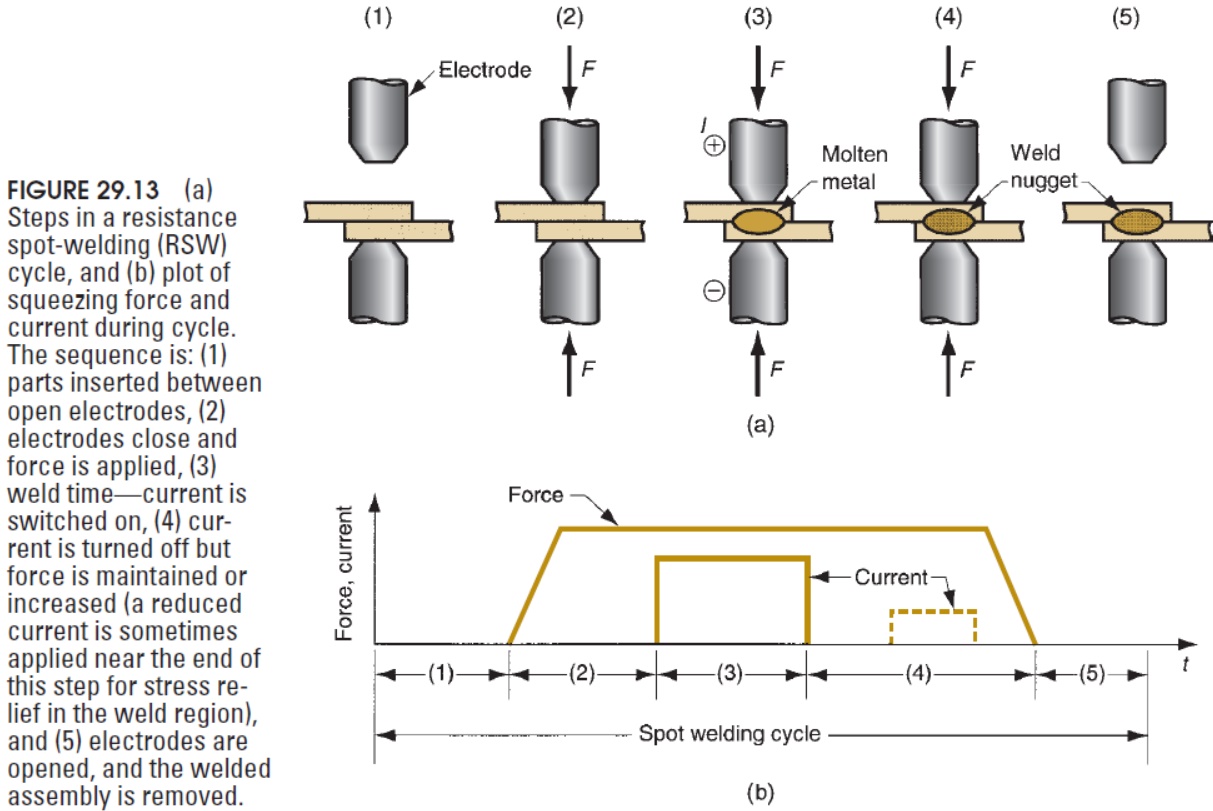
[출처: Mikell P. Groover, Fundamentals of Modern Manufacturing Materials, Processes, and Systems]