잉크젯 프린트 헤드
★ ink jet printing head
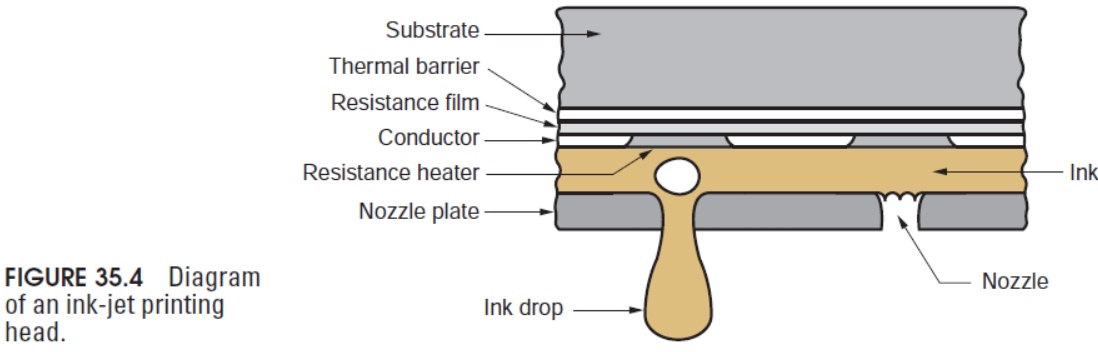
This is currently one of the largest applications of MST, because a typical ink-jet printer uses up several cartridges each year. The operation of an ink-jet printing head is depicted in Figure 35.4. An array of resistance heating elements is located above a corresponding array of nozzles. Ink is supplied by a
reservoir and flows between the heaters and nozzles. Each heating element can be independently activated under microprocessor control in microseconds. When activated by a pulse of current, the liquid ink immediately beneath the heater boils to form a vapor bubble, forcing ink to be expelled through the nozzle opening. The ink hits the paper and dries almost immediately to form a dot that is part of an alphanumeric character or other image. Meanwhile, the vapor bubble collapses, drawing more ink from the reservoir to replenish the supply. Today’s ink-jet printers possess resolutions of 1200 dots per inch (dpi), which converts to a nozzle separation of only about 21 mm, certainly in the microsystem range.
reservoir and flows between the heaters and nozzles. Each heating element can be independently activated under microprocessor control in microseconds. When activated by a pulse of current, the liquid ink immediately beneath the heater boils to form a vapor bubble, forcing ink to be expelled through the nozzle opening. The ink hits the paper and dries almost immediately to form a dot that is part of an alphanumeric character or other image. Meanwhile, the vapor bubble collapses, drawing more ink from the reservoir to replenish the supply. Today’s ink-jet printers possess resolutions of 1200 dots per inch (dpi), which converts to a nozzle separation of only about 21 mm, certainly in the microsystem range.
[출처: Mikell P. Groover, Fundamentals of Modern Manufacturing Materials, Processes, and Systems]