플라이어 방적
★ flyer spinning [방적] 플라이어 방적
[뜻] 영국식 소모방적에 쓰이는 정방 방식으로 굵고 긴 섬유로 방적된 로빙을 다시 가능하게 하는 것. 플라이어가 회전하며 꼬임을 주고 보빈에 감는다. 수편사, 니트사, 카핏사, 모헤어사, 알파카사, 기포용사, 심지용 실 등이 이 방법으로 방출된다.
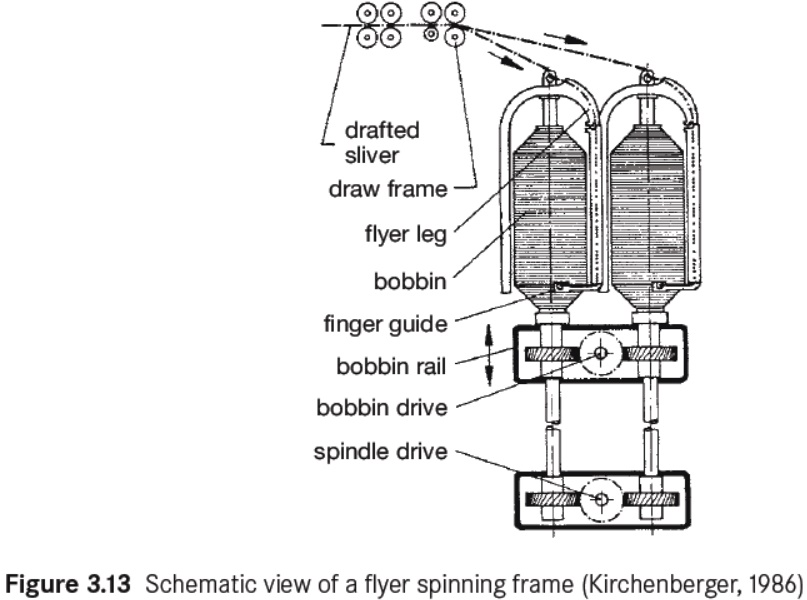
In the first step, the drawn sliver is predrafted in the flyer spinning frame (draw ratio of 1:5 to 1:50), while it is also twisted slightly to prevent wrong drafts. This safety twist has to be small enough to still allow drafting of the flyer yarn to the final yarn titer in the drafting field of the ring spinning machine. Figure 3.13 schematically shows a flyer spinning frame. The sliver is first drafted in the flyer drafting field, which is often designed as a three-roller-two-apron-drafting unit. From the drafting field the drawn sliver is transported over the flyer top into the flyer leg, which it exits at the bottom. A finger guide leads the sliver to the bobbin surface. With this mechanism the sliver obtains one twist with each revolution of the flyer. The winding itself is caused by a lead of the bobbin against the flyer top. The vertical movement necessary for the winding is accomplished by the bobbin. Because the flyer operates at a constant feed speed, the vertical movement and the revolutions per minute have to be adjusted continuously according to the
bobbin diameter. The limit of revolutions per minute for the flyer is about 1300 to 1500 rpm and depends on the maximum feed speed. For a bobbin change, the flyer legs have to be removed, which makes automation difficult. Several more disadvantages associated with the flyer spinning principle include that the stopping of the entire machine is necessary if a sliver breaks. For decades, people have been working on eliminating the flyer process and spinning drawn slivers directly on the ring spinning frame (so-called direct spinning).
[출처: Thomas Gries et al., Textile Technology, 2nd Ed., HANSER]