오픈엔드 로터 정방
★ open end rotor spinning (= OE rotor spinning) 오픈 엔드 로터 정방.
The first functioning rotor spinning machine was presented at ITMA 1967. Yarn formation according to the rotor spinning principle predominates for all nonconventional spinning methods. Worldwide, more than 8 million spindles are in operation (Schindler, 2013).
The feed for rotor spinning is card, drawn, or combed sliver. A feed roller/feed plate unit transports the sliver to the opening cylinder (Fig. 3.18). The opening cylinder rotates at 20 to 30 m/s circumferential speed (5000–8000 rpm), which provides a very intense combing and separation of the fibers. Below the opening cylinder, contamination particles are segregated. The fibers are detached from the clothing with an air stream and accelerated in a conical guiding channel. This channel ends in a rotor rotating with up to 150,000 rpm. Because of their centrifugal force, the fibers slide along the outside of the rotor wall and form a ring-like structure in the rotor groove. Because the fibers are continuously accelerated during this process, their position in the rotor groove is mostly straightened. The spinning is started with the help of a ready yarn end, which is led into the rotor via a pull-off pipe and nozzle. The yarn rotates in the rotor groove, which causes fibers lying in the groove to attach to its end. With the pull-off of the yarn through the nozzle and the uptake pipe, a continuous spinning process takes place. Yarn can be produced in a wide
titer range from 12 to 200 tex.
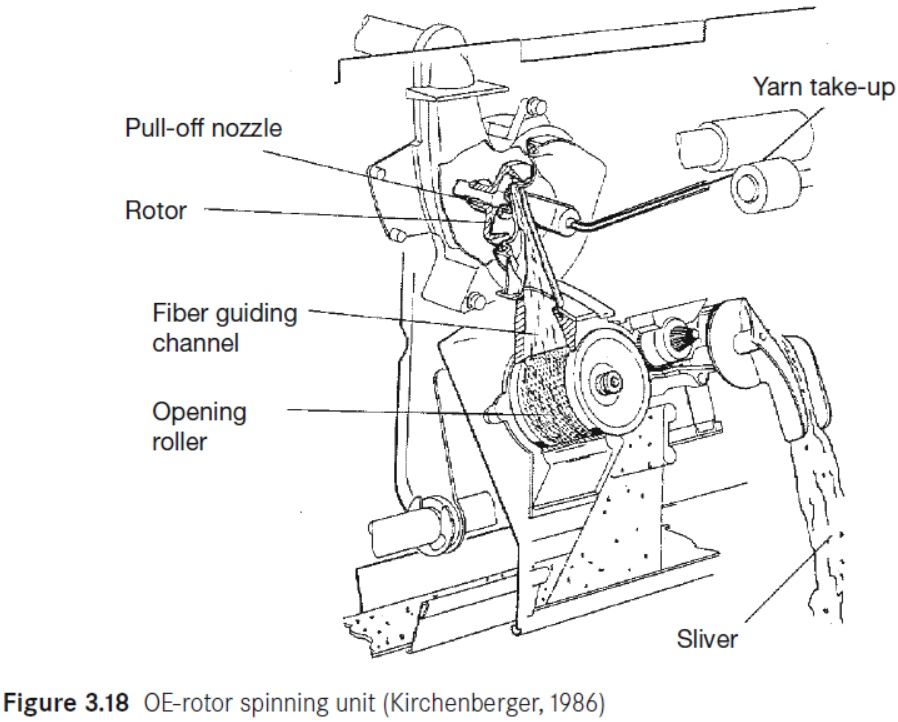
[출처: Thomas Gries et al., Textile Technology, 2nd Ed., HANSER]