기어 형삭
★ gear shaping
In gear shaping, a reciprocating cutting tool motion is used rather than a rotational motion as in form milling and gear hobbing. Two quite different forms of shaping operation (Section 21.6.1) are used to produce gears. In the fi rst type, a single-point tool takes multiple passes to gradually shape each tooth profi le using computerized controls or a template. The gear blank is slowly rotated or indexed, with
the same profile being imparted to each tooth. The procedure is slow and applied only in the fabrication of very large gears.
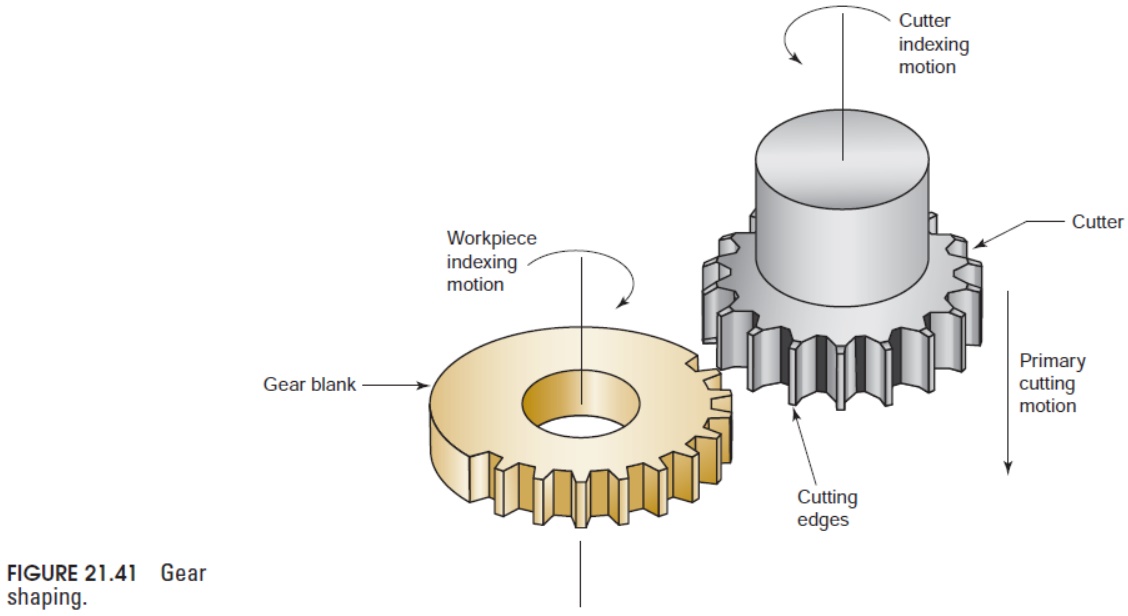
In the second type of gear shaping operation, the cutter has the general shape of a gear, with cutting teeth on one side. The axes of the cutter and the gear blank are parallel, as illustrated in Figure 21.41, and the action is similar to a pair of conjugate gears except that the reciprocation of the cutter is gradually creating the form of the matching teeth in its mating component. At the beginning of the operation for a given gear blank, the cutter is fed into the blank after each stroke until the required depth has been reached. Then, after each successive pass of the tool, both the cutter and the blank are rotated a small amount (indexed) so as to maintain the same tooth spacing on each. Gear shaping by this second method is widely used in industry, and specialized machines (called gear shapers) are available to accomplish the process.
the same profile being imparted to each tooth. The procedure is slow and applied only in the fabrication of very large gears.
In the second type of gear shaping operation, the cutter has the general shape of a gear, with cutting teeth on one side. The axes of the cutter and the gear blank are parallel, as illustrated in Figure 21.41, and the action is similar to a pair of conjugate gears except that the reciprocation of the cutter is gradually creating the form of the matching teeth in its mating component. At the beginning of the operation for a given gear blank, the cutter is fed into the blank after each stroke until the required depth has been reached. Then, after each successive pass of the tool, both the cutter and the blank are rotated a small amount (indexed) so as to maintain the same tooth spacing on each. Gear shaping by this second method is widely used in industry, and specialized machines (called gear shapers) are available to accomplish the process.
[출처: Mikell P. Groover, Fundamentals of Modern Manufacturing Materials, Processes, and Systems]