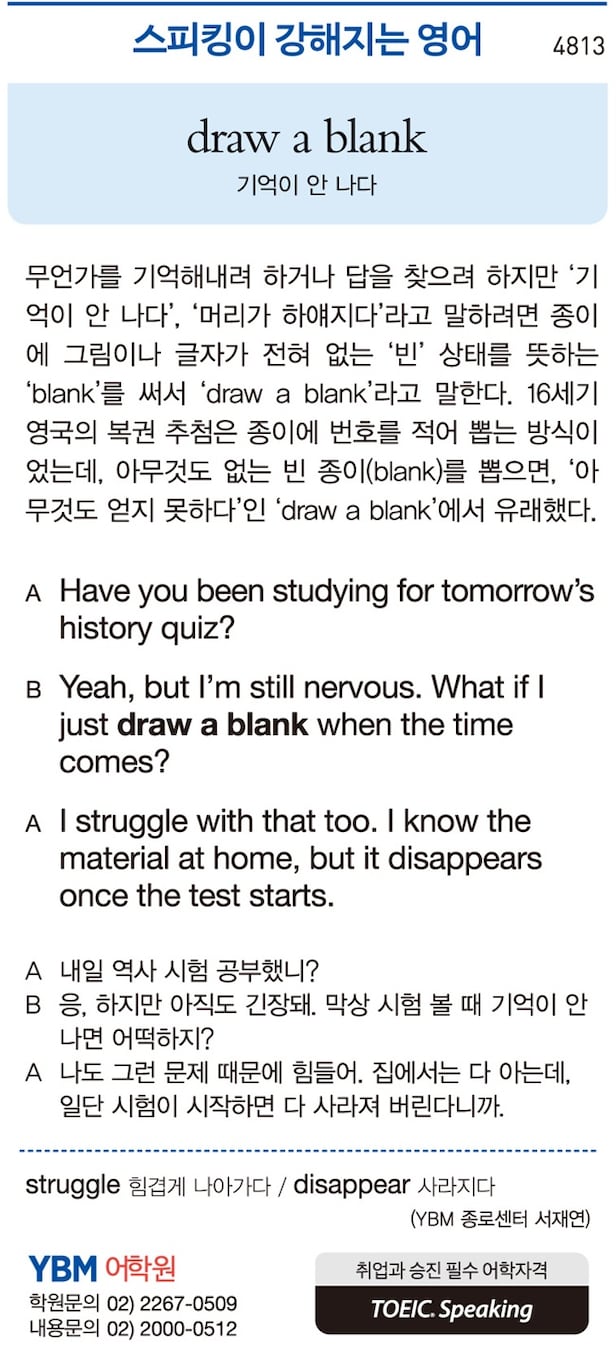
기억이 나지 않다
* I tried to recall her phone number, but I drew a blank and couldn't remember it. 그녀의 전화번호를 떠올리려고 했는데, 기억이 나지 않아서 허탕을 쳤어요.
* When asked about the details of the event, he drew a blank and couldn't provide any information. 그 이벤트에 대한 세부 사항을 물어보면, 그는 기억이 나지 않아서 어떤 정보도 제공하지 못했습니다.
* I drew a blank when trying to remember where I left my keys this morning. 오늘 아침에 열쇠를 어디에 뒀는지 기억이 나지 않아 허탕을 쳤어요.
* Despite racking my brain, I drew a blank on the name of the book I wanted to recommend. 머리를 싸매고 노력했지만, 추천하고 싶은 책의 이름이 기억이 나지 않아 허탕을 쳤어요.
* As I was asked about my plans for the weekend, I drew a blank because I hadn't made any yet. 주말 계획을 묻히자 아직 계획을 세우지 않아서 기억이 나지 않았어요.
* I clearly had too much to drink and blacked out. 나는 정말 술을 너무 많이 마셔서 필름이 끊겼다.
✅ 의미
누가 말한 이름, 정보, 단어 등이 익숙하지 않거나 기억나지 않을 때 “기억에 없다”, “들어본 적 없다”는 뜻으로 사용됩니다. 보통 “That name does not ring a bell.”처럼 ring a bell의 부정형으로 쓰입니다.
✅ 뉘앙스
“전혀 모르겠는데요”보다는 조금 더 부드럽고 간접적인 표현. 상대방의 말을 무례하지 않게 부정할 때 적합. “기억이 안 난다” 또는 “익숙하지 않다”의 완곡한 말투.
✅ 격식
일상 대화에서 매우 흔하게 쓰이는 비격식~중립 표현.
* The name does not ring a bell. 그 이름은 기억이 안 나요.
* That story does not ring any bells. 그 이야기는 전혀 기억이 안 나요.
* His face does not ring a bell. 얼굴을 봐도 기억이 안 나요.
* This place does not ring a bell. 이 장소는 익숙하지 않아요.
* The title does not ring a bell to me. 그 제목은 저한테 익숙하지 않아요.
* Your description does not ring a bell at all. 설명을 들어도 전혀 기억이 안 나요.
* The term does not ring a bell for me. 그 용어는 제게 익숙하지 않아요.
* That event does not ring a bell. 그 사건은 기억에 없어요.
* The name you mentioned does not ring a bell. 말씀하신 이름은 기억이 안 나요.
* The situation does not ring any bells for me. 그 상황은 저에게 낯설어요.
A: Do you know a guy named Tom Rivera?
B: Sorry, the name does not ring a bell.
A: Tom Rivera라는 사람 알아?
B: 미안, 이름이 기억이 안 나.
A: Does this photo ring a bell?
B: No, it does not ring any bells.
A: 이 사진 본 적 있어?
B: 아니, 전혀 기억이 안 나.
A: Have you heard of this book?
B: The title does not ring a bell to me.
A: 이 책 들어봤어?
B: 제목이 익숙하지 않아.
? 유사 표현 비교
| 표현 | 의미 | 뉘앙스/사용상황 | 격식 | 예문 |
|---|---|---|---|---|
| does not ring (a) bell | 기억이 안 난다, 익숙하지 않다 | 상대방 말에 부드러운 부정 | 중립 | The name does not ring a bell. 그 이름은 기억이 안 나요. |
| I don’t recall | 기억이 나지 않는다 | 좀 더 직접적인 표현 | 중립~격식 | I don’t recall that meeting. 그 회의는 기억이 안 납니다. |
| I’m not familiar with it | 익숙하지 않다 | 지식 부족을 설명할 때 | 중립 | I’m not familiar with that term. 그 용어는 익숙하지 않아요. |
| Doesn’t sound familiar | 들어본 적 없는 것 같다 | 일상 대화, 가벼운 톤 | 비격식 | The name doesn’t sound familiar. 이름이 낯설어요. |
* During the exam, his mind went blank, and he couldn't recall the formulas he had studied. 시험 중에 그의 머릿속이 텅 비어버려 공부한 공식을 기억해내지 못했습니다.
* I was so nervous during the presentation that my mind went blank, and I stumbled over my words. 발표 중에 너무 긴장돼 머릿속이 텅 비어버려 말을 더듬었어요.
* When the teacher called on him unexpectedly, his mind went blank, and he couldn't answer the question. 선생님이 갑자기 그를 부르자 그의 머릿속이 텅 비어버려 그 질문에 대답할 수 없었습니다.
* After the accident, his mind went blank, and he couldn't remember the events leading up to it. 사고 후 그의 머릿속이 텅 비어서 그 전의 사건들을 기억해낼 수 없었습니다.
* The title of that book escapes me, but I remember it had a red cover. 그 책의 제목이 기억나지 않지만, 빨간색 표지였던 건 기억해요.
* There’s a word for this condition, but it escapes me at the moment. 이 상태를 설명하는 단어가 있는데, 지금은 기억이 안 나요.
* The exact number escapes me, but I know it was in the hundreds. 정확한 숫자는 기억이 안 나지만, 수백 단위였던 건 확실해요.
* I tried to recall where I’d seen him before, but it completely escaped me. 그를 예전에 어디서 봤는지 떠올리려 했는데, 전혀 기억나지 않았어요.
* Her birthday usually escapes me unless I write it down. 그녀의 생일은 적어놓지 않으면 보통 기억나지 않아요.
* The name of that restaurant escapes me, but it was near the station. 그 식당 이름이 기억나지 않지만, 역 근처에 있었어요.
* I know the password’s somewhere in my head, but right now it escapes me. 비밀번호가 머릿속 어딘가에 있을 텐데, 지금은 도통 기억나지 않아요.
* The reason for his absence escapes me, though I’m sure he mentioned it before. 그가 결석한 이유가 전혀 기억나지 않지만, 전에 언급한 것 같기는 해요.
* The formula escapes me at the moment, so let me look it up. 그 공식이 지금은 기억나지 않아서, 찾아봐야겠어요.