테일러 공법
★ Taylor process [금속섬유] 테일러 공법.
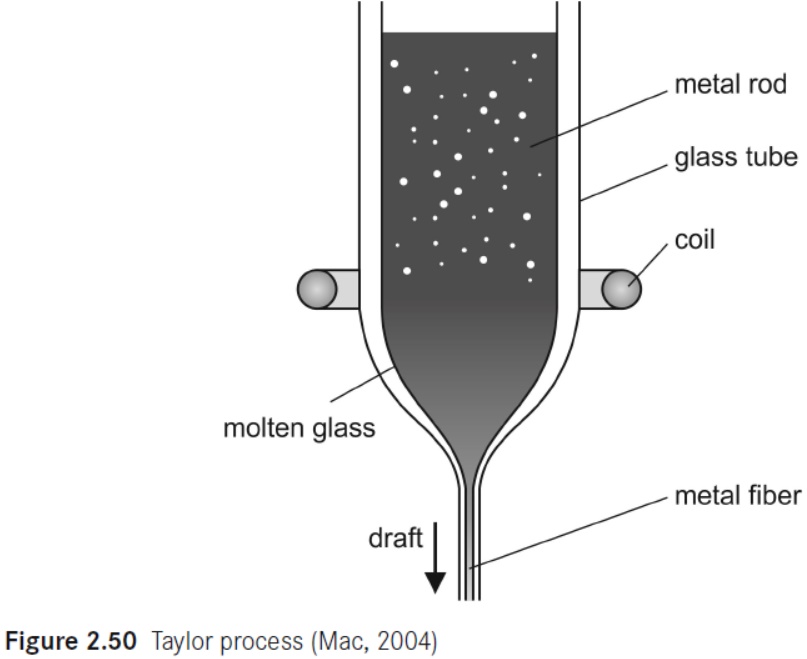
테일러법은 용융 금속을 pylex 유리 같은 점도가 높은 보호재로 감싸고, 반용융 상태에서 보호재와 함께 연신시킨 후 보호재를 화학적으로 제거하여 금속섬유를 제조하는 공법이다. Taylor공법은 Taylor에 의해 최초로 개발되어 1957년 Ulitovskiy에 의해 개선되었으며, melt spinning 공정으로는 유일하게 1 μm 이하의 직경을 가지는 금속섬유까지 제조할 수 있는 공정으로 평가 받고 있다.
In Fig. 2.50, the Taylor process is depicted. Here, a metal rod is molten inside a glass tube with a slightly higher melting point. The electric current in the coil heats up both materials, the wire melts, and the glass tube softens. Then the glass tube is drawn, causing the metal to become very thin. After cooling, the fine metal fibers are taken up whereas the glass tube is crushed, using ultrasound. Fiber diameters can be lower than 50 μm, but production speed is low and the process can only be used for specific metals that do not fuse with the glass tube.
[출처: Thomas Gries et al., Textile Technology, 2nd Ed., HANSER]