초음파 가공
★ ultrasonic machining 초음파 가공(超音波加工)
[뜻] 공구와 공작물 사이에, 숫돌립과 물 또는 기름의 혼합액을 넣고 공구에 초음파 진동을 주어 공작물의 구멍뚫기, 연삭, 절단, 용접 등을 행하는 가공법.
Ultrasonic machining (USM) is a nontraditional machining process in which abrasives contained in a slurry are driven at high velocity against the work by a tool vibrating at low amplitude and high frequency. The amplitudes are around 0.075 mm (0.003 in), and the frequencies are approximately 20,000 Hz. The tool oscillates in a direction perpendicular to the work surface, and is fed slowly into the work, so that the shape
of the tool is formed in the part. However, it is the action of the abrasives, impinging against the work surface, that performs the cutting. The general arrangement of the USM process is depicted in Figure 25.1.
of the tool is formed in the part. However, it is the action of the abrasives, impinging against the work surface, that performs the cutting. The general arrangement of the USM process is depicted in Figure 25.1.
Common tool materials used in USM include soft steel and stainless steel. Abrasive materials in USM include boron nitride, boron carbide, aluminum oxide, silicon carbide, and diamond. Grit size (Section 16.1.1) ranges between 100 and 2000. The vibration amplitude should be set approximately equal to the grit size, and the gap size should be maintained at about two times grit size. To a signifi cant degree, grit size determines the surface fi nish on the new work surface. In addition to surface fi nish, material removal
rate is an important performance variable in ultrasonic machining. For a given work material, the removal rate in USM increases with increasing frequency and amplitude of vibration.
rate is an important performance variable in ultrasonic machining. For a given work material, the removal rate in USM increases with increasing frequency and amplitude of vibration.
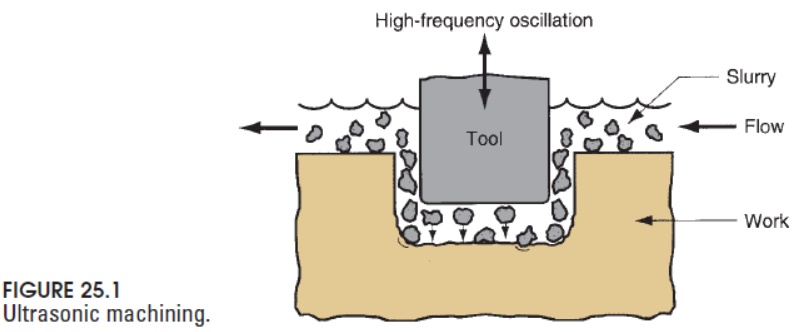
[출처: Mikell P. Groover, Fundamentals of Modern Manufacturing Materials, Processes, and Systems]